
Stamford alternators · On site
Stamford Alternator Repairs and AVR Diagnosis
ProService Generator Repairs services and repairs Stamford alternators. When the engine runs and the voltage is missing, low or will not hold, we work out which Stamford excitation system your machine uses, test the AVR, exciter and rotating diodes in that order, and give you a written quote before any part is changed. ProService Generator Repairs is an independent generator service and repair company.
Callout fee waived when you accept our written quote. 1-year workmanship guarantee. See prices
- Self-excited and PMG systems
- AVR tested before it is replaced
- Rewind only when tests call for it
- 1-year workmanship guarantee
- Onsite across Gauteng
Know your machine
Why the excitation system decides the repair on a Stamford alternator
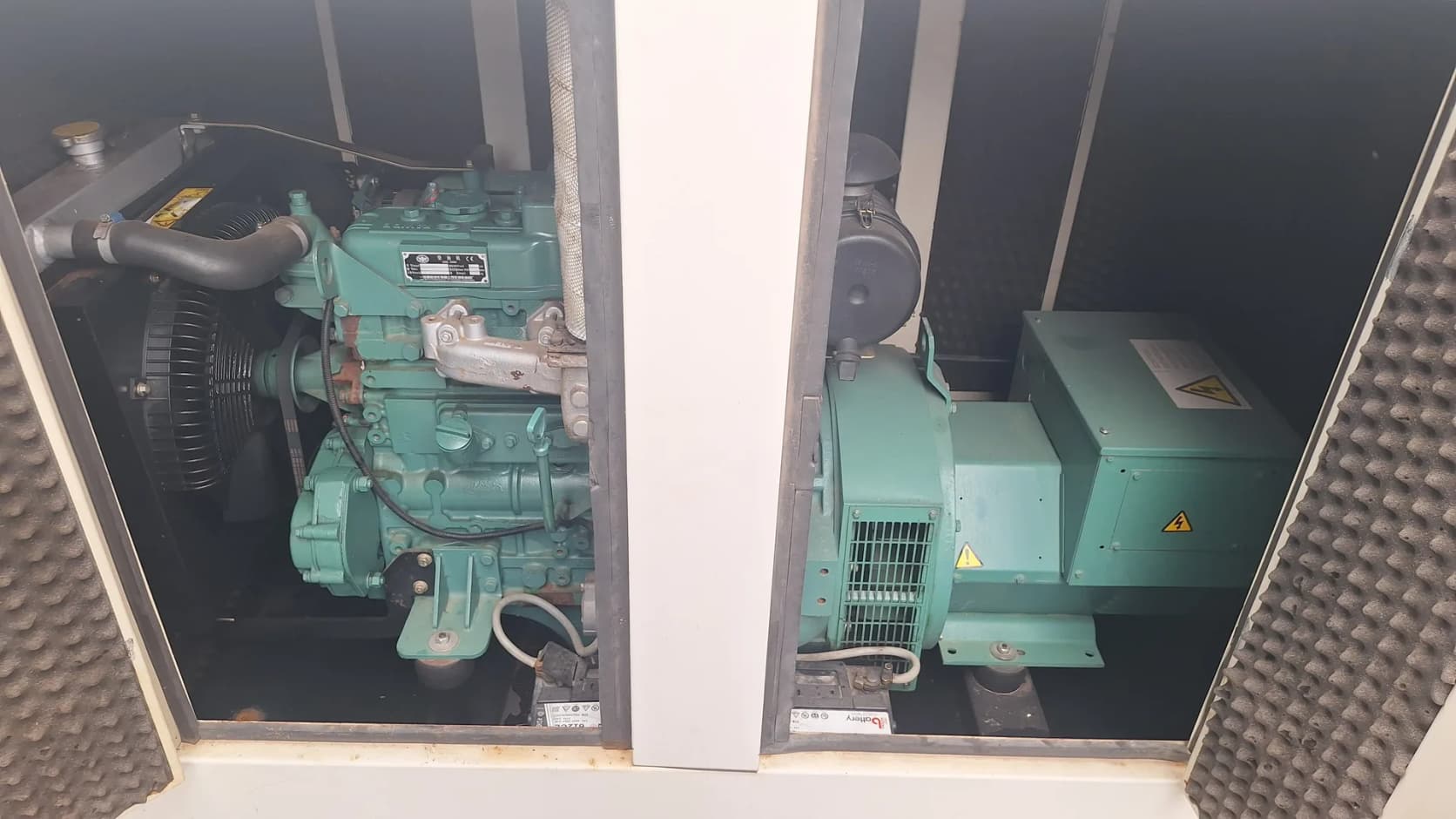
Stamford alternators sit on a wide range of diesel generator sets, from small S0 and S1 frames on compact sets to UC, HC and the newer S-range frames on large standby generators. The engine beside it may be a Perkins, Cummins, Deutz or another make, so the engine badge on the canopy tells us nothing about the electrical end. The alternator nameplate does.
The most useful thing on that plate, for a fault-finder, is how the machine is excited. On a self-excited Stamford, the AVR (commonly an AS440, or the older SX460 on earlier machines) takes its power from the alternator’s own output and builds voltage up from the small residual voltage left in the machine. On a PMG-excited Stamford, a permanent magnet generator on the shaft feeds the AVR (commonly an MX341, or an MX321 where three-phase sensing is needed), so excitation does not depend on the output voltage at all.
That difference changes the fault-finding. A self-excited machine that has lost its residual voltage, or has a failed rotating diode, may give almost nothing at the terminals even though the AVR is healthy. A PMG machine with no output points first at the PMG supply, the AVR or the exciter. Replacing the AVR before the excitation system is understood is an easy way to spend money and keep the fault.
All generator repairs and engine overhauls are carried out on site at your premises. Testing and repair happen at your premises. A rewind is a separate job, recommended only when winding and insulation tests show the copper or the insulation has failed.
Excitation systems
The Stamford AVRs and what each one tells us
The AVR model is printed on the regulator, usually inside the alternator terminal box. A photo of it before the visit lets us bring the right replacement if one is needed.
AS440: self-excited
Powered from the main stator. Builds voltage from residual magnetism, so a machine that has stood for a long time, or had its field reversed, may need the residual restored before it will excite. Supports a droop transformer on sets that run in parallel.
SX460: self-excited, older machines
The earlier self-excited regulator, found on older Stamford machines. Some newer Stamford data sheets mark it as obsolete, so a replacement may be a different model wired to suit. We confirm the match before ordering.
MX341: PMG-excited
Fed by the permanent magnet generator, so excitation holds up during motor starting and heavy load steps. It has built-in over-excitation protection that shuts the excitation down, which can look like a dead AVR when it is protecting the machine.
MX321: PMG with three-phase sensing
Adds three-phase rms voltage sensing to the MX341’s features. Stamford recommends it for unbalanced or highly non-linear loads, so swapping it for a single-phase-sensing regulator can bring back the voltage problem it was fitted to solve.
How we test
Our Stamford test sequence, quickest check first
Each step either finds the fault or clears a part, before anything is dismantled or ordered.
01
Engine speed
Voltage follows speed. We confirm the engine holds its governed speed and frequency under load before we judge the alternator.
02
Breaker, terminals and sensing
An open breaker, a loose sensing lead or a burnt terminal in the box can mimic an AVR fault. We check the wiring the AVR reads before the AVR itself.
03
Excitation supply
On a PMG machine we measure the PMG output to the AVR. On a self-excited machine we check whether there is enough residual voltage for the AVR to build on.
04
AVR output and settings
We measure what the AVR sends to the exciter, and check its voltage, stability and protection settings against a meter, not by eye.
05
Rotating diodes and surge suppressor
A failed diode or suppressor on the rotating rectifier is a common, inexpensive cause of low or no voltage on a sound machine. We test them before anyone mentions windings.
06
Windings and insulation
Only when everything upstream passes do we test the exciter, rotor and stator windings and their insulation, which separates a repair from a rewind.
Stamford alternator symptoms, likely causes and repairs
Use this to describe what you see when you call. The excitation system on the nameplate changes which cause is most likely, so tell us the AVR model if you can read it.
| What you see | Likely cause | Usual repair |
|---|---|---|
| Engine runs, no voltage at all | Self-excited: lost residual voltage or a failed rotating diode. PMG: no PMG supply or a failed AVR | Restore excitation, replace the diode set or the AVR once the test confirms it |
| Low voltage that will not adjust up | One open diode, a weak exciter, engine running slow, or a sensing lead fault | Test diodes and the exciter; set the engine speed; repair the sensing wiring |
| Voltage hunts or lights flicker | Engine speed hunting, AVR stability set wrongly, or a loose connection | Settle the engine governor first, then set the AVR stability against a meter |
| Voltage high, or shuts down soon after starting | Lost sensing to the AVR, or over-excitation protection acting | Take the set off load; find why the AVR is not seeing the output |
| Fine off load, collapses on load | Diodes or exciter failing under heat and current, or the load is beyond the set | Load test with a meter on the excitation; check the load against the rating |
| Burnt smell, heat or bearing noise at the alternator | Insulation breakdown, overload or a worn bearing | Stop the set; insulation tests decide between a repair and a rewind |
AVR replacement typically costs R2,200 to R9,000 and alternator rewinding R6,000 to R18,000+. Both are listed on our generator repair cost guide, and you get a written quote before any work.
Common Questions
Stamford alternator questions
Do you repair Stamford alternators?
Yes. ProService Generator Repairs services and repairs Stamford alternators. We test and repair them on site across Gauteng, whichever engine drives them. Brand names and trademarks belong to their owners and are used only to describe the equipment we work on. ProService Generator Repairs is independent and is not a dealer, agent or partner of any manufacturer.
How do I tell if my Stamford alternator is self-excited or PMG?
Look at the AVR model in the terminal box, or send us a photo of it and the nameplate. An AS440 or SX460 is self-excited. An MX341 or MX321 is fed by a permanent magnet generator, a small extra machine at the non-drive end of the shaft.
My Stamford alternator gives no voltage. Is the AVR broken?
Not necessarily. A self-excited machine can lose its residual voltage after standing, and a failed rotating diode stops excitation on any Stamford. Both look like a dead AVR. We test the excitation supply and the diodes before we replace the regulator.
Can I flash the field myself?
No. Restoring residual voltage involves a live alternator and the correct polarity and procedure for the AVR fitted. Done wrongly it can damage the AVR or the insulation. Leave the terminal box closed and call us.
Can a different AVR be fitted to a Stamford alternator?
Sometimes, when the original is no longer made, but the replacement has to suit the excitation system and the sensing the machine needs. Fitting a single-phase-sensing regulator where an MX321 was specified can bring back unbalanced-load voltage problems.
Do you rewind Stamford alternators?
Yes, when winding and insulation tests show a rewind is the right repair. Many no-voltage and low-voltage faults are fixed without one. Rewinds are handled through our generator rewinding service.
Is Stamford the engine on my generator?
No. Stamford makes alternators, the electrical end of the set. The engine is a different make, and its plate decides the engine parts.
What should I send before the visit?
Photos of the alternator nameplate and the AVR, the generator kVA, and a description of the voltage fault: none, low, high or unstable, and whether it changes with load.
Still unsure what the fault is? Call or WhatsApp 082 057 4605 for onsite diagnosis.
Related Pages
Alternator, AVR and voltage guides
- Alternator Repairs Output faults on any make
- AVR Repairs Regulators on every alternator make
- Generator Rewinding When winding tests call for it
- Leroy-Somer Alternators The other common alternator make
- Not Producing Power Engine runs, board stays dark
- Unstable Voltage Voltage that will not settle
- Load Bank Testing Proving the repair under load
- Diesel Generator Repairs When the engine is the fault
Service Areas
Onsite visits across Gauteng
We come to your generator anywhere in Gauteng, 24/7. Choose your region for local suburbs, call-out details and the faults we see most there.
What to send before we attend
These details help us plan the visit and bring the right parts. Send what you can on WhatsApp; if you can’t find the model number, we still book the visit.
- Location
- The suburb or site, so the visit can be booked in the right area.
- Make and model
- The generator brand and model, if they are known.
- kVA
- The size printed on the data plate.
- Fuel type
- Diesel, petrol, LPG, natural gas, or dual-fuel.
- Controller model
- The module name on the panel, when it is visible.
- Fault or alarm
- What the set does, and any text on the screen.
- Photos
- The generator, the data plate, and the controller or alarm. Send these on WhatsApp.
Book a Visit
Describe the voltage fault
Tell us whether the voltage is missing, low, high or unstable, and send a photo of the alternator nameplate and the AVR if you can. Please keep the terminal box closed.
- Call
- 082 057 4605
- Message us on WhatsApp
What happens next
- We reply with questions about the generator, or to book a visit.
- A technician comes to you. For a breakdown we arrive within 1 hour.
- The fault is diagnosed on site and you get a written quote. No work starts until you accept it.
Charlie, lead technician: Degree in Mechanical Engineering, Degree in Electrical Engineering, Diesel Plant Fitter. Generator specialists since 2000.