
Will not start
Battery, starter, controller, fuel supply at a symptom level, ignition, or a latched shutdown.
Onsite generator repairs, servicing & maintenance across Gauteng
Generac generator specialists
ProService Generator Repairs provides independent repair and servicing support for supported Generac generator systems. Fuel configuration depends on the specific generator model. LPG and natural-gas standby sets are diagnosed on site. Petrol is not assumed.
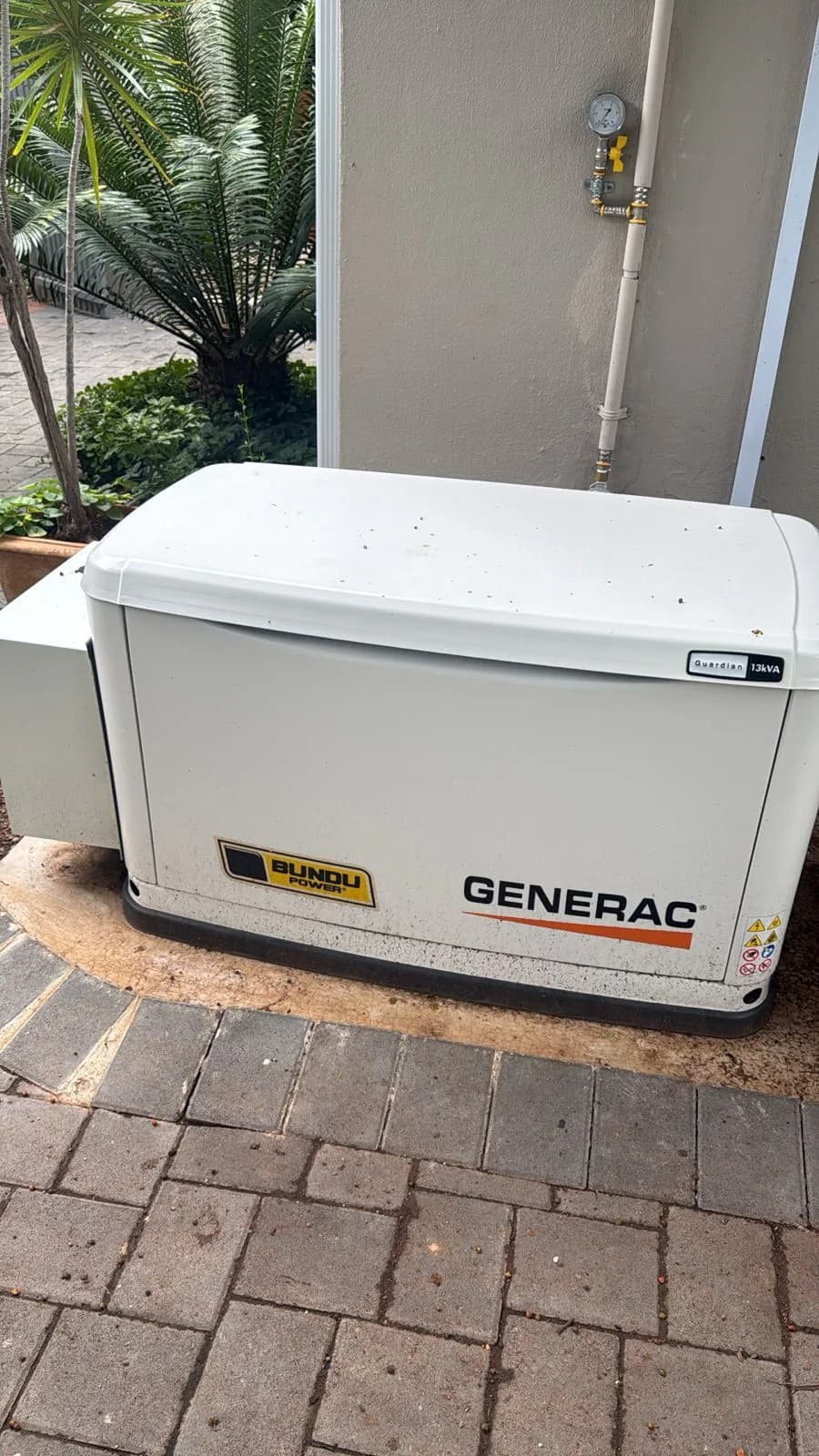
A Generac visit starts with the machine that is installed, not with a catalogue of every Generac ever built. Some standby systems are set up for LPG. Some are set up for natural gas. The data plate and the fuel connection tell the technician which one this is. ProService Generator Repairs is not an authorised Generac dealer, service centre, warranty agent or certified partner.
Repairs cover the engine side that will or will not start, the controller that is showing an alarm, the battery that should crank the set, and the electrical output once the engine is running. Automatic-start behaviour is part of that picture on a standby set: the unit may be silent because it never received a start command, or it may start and then shut down on a fault.
Gas-supply installation and certification stay with appropriately qualified gas practitioners. ProService Generator Repairs does not modify regulators, bypass safety devices, change gas-pressure settings, or alter pipework. The generator visit diagnoses the set. It does not become a DIY gas conversion.
Servicing a Generac standby set is a planned inspection, not a copied service interval from a brochure. Where the engine uses them, oil, the oil filter, the air filter and spark plugs are checked. The starting battery and its terminals are checked, because a standby set that sits for weeks still has to crank when the supply drops.
Cooling airflow, the controller display, and a generator output check are part of the same visit. Where automatic-start testing and ATS operation are in the agreed scope, they are watched as a system: does the set start, and does the load move. A visual inspection notes leaks, loose covers and anything that would stop the next automatic start.
Manufacturer hour intervals are not invented here. The service follows the condition of this set and what the controller is already reporting. A maintenance alarm is recorded and diagnosed. It is not cleared for the sake of a quiet screen.
Some Generac standby generator systems are designed for LPG. Some are designed for natural gas. Which fuel this installation uses depends on the model and how it was configured. A natural-gas set is not described as an LPG set, and the reverse is not assumed either.
This page does not treat Generac as a petrol brand. Petrol capability is not implied unless a specific verified model on site supports petrol. If the set in front of the technician is a gas standby unit, the diagnosis stays on that fuel system at a symptom level: the engine is not receiving a start, it starts and stops, or it runs and the output is wrong.
Symptoms around fuel delivery are reported. They are not turned into instructions for adjusting a regulator or improvising a connection. If the gas supply itself needs installation or certification work, that is handed to a qualified gas practitioner.
An automatic Generac standby set is supposed to notice a supply failure, start, and carry the load. When it does not, the fault can sit in the controller, the battery, a shutdown that is already latched, or the transfer equipment that never left the mains position.
Residential standby is the common Generac booking: a house set in an enclosure, expected to run without someone pulling a rope. Commercial standby is booked where that larger system is supported and the visit can be arranged. Both are still independent repairs. Neither is a claim that every commercial Generac can be taken on.
A Generac that will not start is split before parts are named. The battery may be too weak to crank. The starter may click and stop. The controller may be holding a shutdown. The fuel supply may be present at the installation and the engine may still not fire. Ignition on a spark-ignited gas engine is checked as an engine fault, not as a gas-pipe modification.
The owner’s description matters. “It did nothing when the power went off” is a different visit from “it cranked and died” or “it ran and the house stayed dark.” Each of those is written down before the enclosure is opened.
No-start work links to the same starting diagnosis used on other ProService Generator Repairs visits, with the gas standby context kept in view.
Generac controllers show warnings, shutdowns and maintenance alarms. The useful step on site is to record the alarm or code exactly as it is displayed, then diagnose that condition. Alarm definitions are not guessed from memory of a different model.
A failed-start alarm, a shutdown that returns as soon as auto is selected, and a maintenance reminder are not the same repair. Auto-mode problems are checked against the switch position and the controller state. Clearing a code without finding why it set is not the job.
Transfer symptoms are kept high level. The generator may start and the load may stay on the mains position. The set may never receive a start command. The transfer equipment may not move when it should. Wiring and control signals between the controller and the transfer gear are part of that inspection.
ATS and AMF behaviour is diagnosed. It is not redesigned, and safety devices in the transfer path are not bypassed. If the fault is a start command that never arrives, that is reported as a control fault. If the set is running and the load never moves, that is reported as a transfer fault.
A standby Generac lives or dies on the starting battery. Weeks of sitting with a charger that is not actually charging produces a set that clicks once and gives up on the night it is needed. Terminals, the battery condition and the charging path are checked together.
A new battery is not the automatic answer when the charger never replaced what the last start took. The charging system is part of the diagnosis on an automatic set.
When a Generac engine is running and the building still has no generator power, the fault has moved to output. The breaker, the wiring, the AVR, the alternator and the control system are inspected in an order that proves the simple faults first. Engine speed is included, because unstable speed moves the voltage.
No output, low output and output that wanders under load are three findings. They do not share one part. A set that starts and makes no power is not treated as another no-start.
House Generac sets are usually enclosed standby units expected to start on their own. The visit respects that: battery, controller, auto mode, and whether the fuel the installation uses is LPG or natural gas. Neighbours and access matter on a residential callout, and the enclosure is inspected rather than assumed.
Commercial Generac standby is considered where the system is supported and a visit can be arranged. The same diagnostic split applies: start, control, transfer and output. A commercial load is not guessed. It is discussed so a voltage complaint can be checked against the way the set is actually used.
Larger sets still do not turn this page into a diesel Cummins or Kohler visit. The fuel and the controller on this Generac are what get diagnosed.
These are the Generac standby faults that justify a visit. Each one is confirmed on the set. Gas-supply work that needs a qualified practitioner is not folded into the generator repair.
Battery, starter, controller, fuel supply at a symptom level, ignition, or a latched shutdown.
Auto mode, the controller, the battery, the ATS command, or an alarm already present.
An alarm, a sensor, operating conditions, ignition, or a fuel-supply fault reported for a qualified follow-up.
AVR, alternator, breaker, wiring or the control system, once the engine is running.
The displayed alarm or code is recorded and diagnosed. Codes are not invented.
A standby battery that cannot crank, or a charger that never recovered it.
The set starts and the load stays on mains, or no start command arrives.
Repairs and servicing without an authorised-dealer or warranty-centre claim.
LPG and natural gas are not swapped. Petrol is not assumed.
Auto start, the battery and transfer symptoms are part of the visit.
Controller messages are written down before they are cleared.
Major area pages are linked below. Suburbs stay on those area sites.
Generac standby visits are arranged from the major Gauteng areas already on the site.
Google Review
The team did a fantastic job installing and calibrating our Generac home standby gas unit, checking all pressure valves and ensuring the firmware was perfectly updated.
Google Review
True Generac gas specialists.
Yes. ProService Generator Repairs provides independent repairs for supported Generac gas generator systems. Fuel type depends on the model and how that set is configured.
Yes. Supported residential standby sets are serviced, and commercial standby is considered where that system can be taken on.
Yes. The battery, starter, controller, ignition and any latched shutdown are checked. Fuel-supply symptoms are reported. Gas pipework is not modified.
Yes. The alarm or code on the display is recorded and diagnosed. Definitions are not guessed for a different model.
Yes. Auto mode, the starting battery, control signals and alarms are inspected when a set fails to start on its own.
Yes, at a diagnostic level. A set that starts while the load stays on mains, or a set that never receives a start command, is inspected. Safety devices are not bypassed.
Yes, where that fuel is what the installed set uses. An LPG configuration and a natural-gas configuration are not treated as the same machine.
Yes. Breakers, wiring, the AVR and the alternator are checked after the engine is running.
Contact ProService Generator Repairs for independent Generac generator repairs, servicing and fault diagnosis on supported LPG and natural-gas standby systems.